



Tiny camera uses metasufrace to emulate a conventional lens

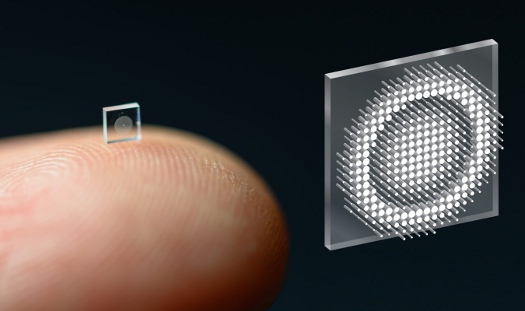
Researchers at Princeton University and the University of Washington have developed an ultracompact camera the size of a coarse grain of salt. The system relies on a technology called a metasurface, which is studded with 1.6 million cylindrical posts and can be produced much like a computer chip. [Image courtesy of the researchers]
New camera fabrication technique yields camera 1/500,000 the volume of a conventional camera. It has 1.6 million cylinders which make up the "lens". Each pillar is the size of the human immunodeficiency virus (HIV). It will be very interesting to see what lies behind the lens and how data is processed.
The image below showing a previous metasurface camera and the right showing the improved technique. Previous micro-sized cameras (left) captured fuzzy, distorted images with limited fields of view. A new system called neural nano-optics (right) can produce crisp, full-color images on par with a conventional compound camera lens. [Image courtesy of the researchers]
It will only get better from here.





Please complete your information below to login.
Sign In
Create New Account